
Did your Eagles -3.5 ticket survive Monday night?
If it didn’t, you already know the lesson Week 3 was teaching. NFL underdog betting odds are a price, not a prediction, and that price gets soft when a backup quarterback walks onto the field. When a 38-year-old who hadn’t started since 2023 beat the Philadelphia Eagles 27-7 as a 3.5-point home underdog, the market didn’t get unlucky so much as it got caught paying too much attention to a name on a depth chart.
Below is the process I’d actually work through before touching an underdog line in a backup-QB spot. It won’t make you a winner, because the house margin never goes away, but it will stop you from misreading what the number in front of you means.
Step 1: Read the spread and the moneyline as two separate questions
These are not two ways of betting the same thing. They ask you different questions, and confusing them is the most common beginner error in NFL betting.
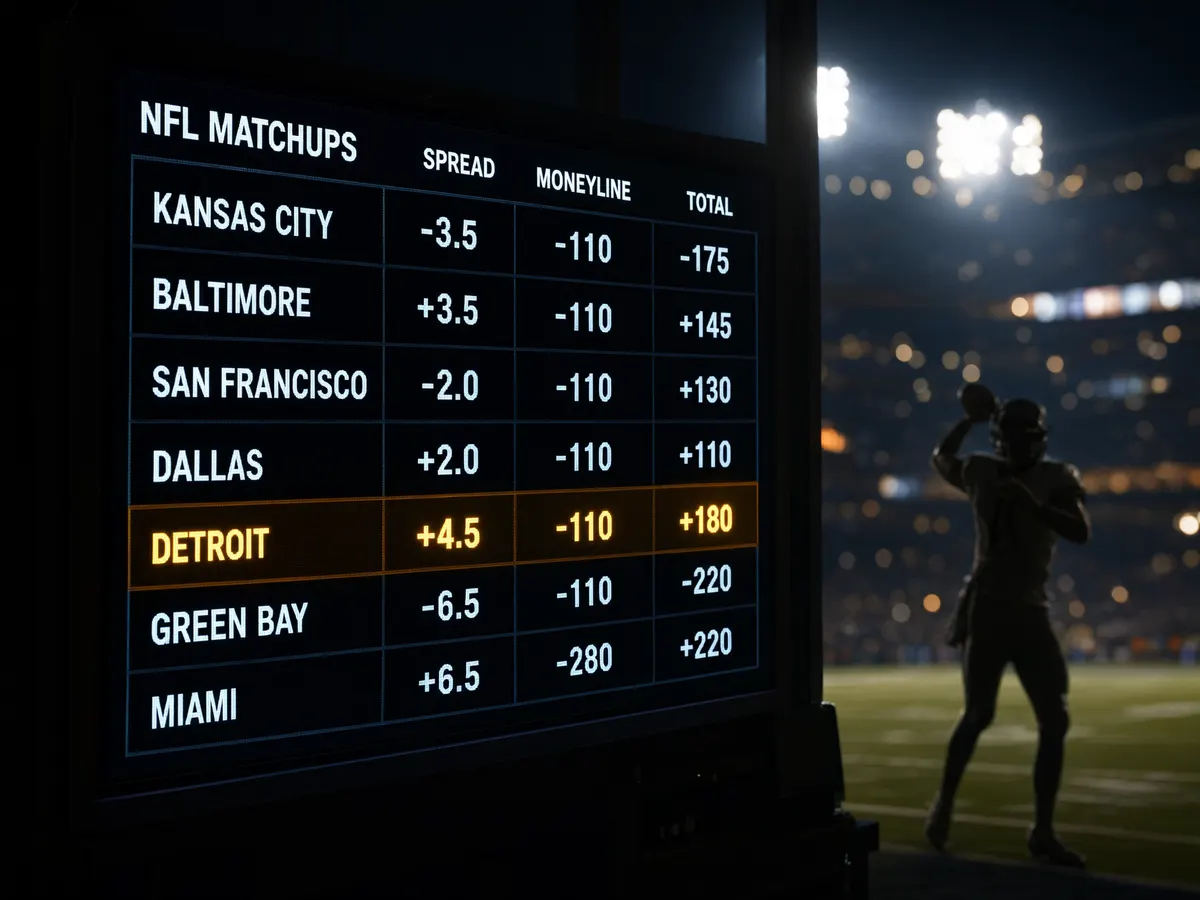
- Point spread: a handicap. Chicago +3.5 means the Bears’ final score has 3.5 points added to it for settlement purposes. They can lose by three and your bet still wins. That’s the “point spread explained” version in one sentence.
- Moneyline betting: who wins, full stop. No handicap, no half-points. A moneyline underdog pays more because it has to actually win the game.
So in Bears +3.5 versus Eagles -3.5, a one-point Chicago loss splits those two markets: spread bettors on the dog cash, moneyline bettors on the dog don’t. Decide which question you’re answering before you look at the price.
Step 2: Convert the price into a probability before you form an opinion
An underdog is only “value” relative to how likely you think the outcome is. Do the arithmetic first, then argue.
For American odds, a plus price converts like this: 100 ÷ (odds + 100). A +155 underdog implies 100 ÷ 255, or about 39%. A minus price: odds ÷ (odds + 100). A -175 favourite implies 175 ÷ 275, about 64%. In decimal terms it’s simpler still, 1 ÷ decimal odds.
Now add up both sides. Standard -110/-110 spread pricing implies 52.38% each way, which totals 104.76%. That extra 4.76% is the overround, the book’s margin baked into the market. Every bet you place has to clear it. That’s the honest starting point for any discussion of sports betting value: you need to be right more often than the price implies, not just right.
Step 3: Size the quarterback downgrade honestly
Here’s where Week 3 gets interesting. Craig Mucklow, vice president of trading at Caesars Sportsbook, put the blame for the upset wave squarely on opening numbers rather than on the bettors who attacked them. With backup quarterbacks sitting 7-3 straight up on the season at that point, he argued, “the bigger mistake has been in the original numbers, not the betting that followed.” He also noted the Eagles “drew heavy support in a perceived No. 1 versus No. 3 quarterback mismatch.”
That phrase, perceived mismatch, is the whole ballgame. Backup quarterback impact is real, and oddsmakers move lines by points, not fractions, when a starter is ruled out. But the market tends to price the gap in reputation rather than the gap in on-field output for one specific Sunday, especially when:
- the backup is an experienced veteran with real starts on his résumé, not an untested rookie;
- the offence is scheme-heavy and doesn’t ask the quarterback to create much on his own;
- the defence and running game are unchanged, which is most of a football team;
- the opponent also has to travel, play in bad weather, or handle a short week.
Case Keenum, starting because both Caleb Williams and Tyson Bagent were injured, went 24-of-34 for 247 yards and two touchdowns against Philadelphia. That is not a heroic stat line. It’s a competent one, and competent was worth more than 3.5 points.
The Week 3 backup ledger
Straight-up records for the backups the market had to price, as reported by Caesars:
| Quarterback | Team | Record in relief |
|---|---|---|
| Drew Lock | Seattle Seahawks | 2-0 (with Sam Darnold injured) |
| Carson Wentz | Minnesota Vikings | 2-0 |
| Jameis Winston | New York Giants | 1-1 |
| Cooper Rush | Atlanta Falcons | 0-2 |
| Marcus Mariota | Washington Commanders | Beat Seattle 33-31 |
| Case Keenum | Chicago Bears | Beat Philadelphia 27-7 |
Backups 7-3 straight up sounds damning. Keep your head about it: that’s ten games, some of those wins came as favourites, and a straight-up record tells you nothing about margins or covers. It’s a flag worth checking, not a system.
Step 4: Look at the closing numbers, not the narratives
Week 3 was brutal for chalk. Five sizable favourites lost outright, and two more won without covering. The spreads are the useful part here, because they show you exactly how much the market was asking you to pay.
| Favourite | Spread | What happened |
|---|---|---|
| Seattle Seahawks | -8.5 | Lost 31-33 to Washington |
| Green Bay Packers | -4.5 | Lost 14-35 to Atlanta (+4.5) |
| Philadelphia Eagles | -3.5 | Lost 7-27 to Chicago |
| Cincinnati Bengals | -2.5 | Lost to Pittsburgh |
| Carolina Panthers | -1.5 | Lost to Cleveland |
| San Francisco 49ers | -7.5 | Won 36-30, no cover |
| Detroit Lions | -7.5 | Won 31-24, no cover |
Two things jump out. First, a defending champion priced at -8.5 lost outright to a team starting Marcus Mariota, which tells you the market was still charging a champion’s premium. Second, the 49ers and Lions results show the difference between winning and covering: a six or seven point win is a loss at -7.5.
Notice also the half-points. Three is the most common margin of victory in the NFL, which is why -3.5 and +3.5 are meaningfully different prices from -3 and +3. Buying or selling that half-point matters more than it does anywhere else on the board.
Step 5: Ask who the public was on, and what that did to the price
Lines move for two reasons: new information, and money. When a starting quarterback is ruled out on a Friday, that’s information, and the number adjusts fast. What happens afterwards is money, and money has a bias. Bettors like favourites, big brands, and primetime storylines, and they like stacking them in parlays.
Joey Feazel, head of football at Caesars Sportsbook, described Washington holding on against Seattle as “another favourable key result for the book, as Seattle’s moneyline had become a popular addition to parlays throughout the week.” That’s the tell. When one side of a market becomes a parlay staple, its price gets shaded, and the other side, the underdog, gets a little cheaper than the football alone justifies.
That doesn’t mean “always bet dogs.” It means the underdog price is where the market’s inefficiency is most likely to sit, so that’s where your scrutiny pays off most.
Step 6: Don’t forget the total moves too
A quarterback change doesn’t only shift the spread. It shifts expectations of how the game gets played, and totals markets react. Week 3’s late window went the other way from the favourites: “The later afternoon games turned into an Over bettor’s dream, with points piling up and Totals cashing across the board,” Feazel said. A late field goal in San Francisco’s 36-30 win over Arizona simultaneously secured the Cardinals’ cover.
If you’ve concluded a backup will make an offence more conservative, that thesis belongs in the totals market as much as the spread, and you should check whether the number has already moved before you act.
Step 7: Write down what would make you wrong
“Sometimes it’s better to be lucky than good,” Mucklow said of the Bears’ win, and traders talking about their own book are usually the most honest voices in this industry. A 20-point win by a 3.5-point underdog is not proof that the line was 20 points wrong. It’s one sample from a wide distribution.
So before you back an underdog because a backup is starting, be specific about the edge you think you have. Is it that the market overrates this particular starter? That the defence carries the team? That the opponent is on a short week, like Cleveland heading into a Thursday divisional game against Pittsburgh after beating Carolina? Those are testable claims. “Backups are 7-3” is not, and a 3-0 Minnesota team quietly winning 23-16 over Tampa Bay while nobody backed them is a reminder that the profitable side is rarely the loud one.
Why any of this matters if you bet
Because the practical takeaway from Week 3 isn’t “fade favourites.” It’s that the number you’re offered is a market’s best guess with a margin stapled on top, and quarterback news is one of the few moments each week where that guess is made in a hurry, under pressure, with incomplete information. Understanding how spreads, moneylines and implied probability fit together is what lets you tell a mispriced underdog from a bad team you simply feel sorry for.
Keep the honest frame in view: bookmakers build a margin into every market, most bettors lose over time, and no reading of a line changes that. Set a budget you’re comfortable losing, use the deposit and loss limits your sportsbook offers, and treat single-week results, yours or the book’s, as noise rather than proof. If betting stops being entertainment, use the cool-off or self-exclusion tools rather than chasing.
FAQ
How much does a backup quarterback move an NFL point spread?
It varies with the gap between the two players and how much the offence depends on the starter. A downgrade from an elite starter typically moves a line by several points; a swap between two similar veterans may move it barely at all. The market prices reputation as well as ability, which is exactly where disagreements, and value, show up.
Is it better to bet an underdog on the spread or the moneyline?
Depends on your read. Take the spread if you think the game will be close but you’re unsure who wins, since the handicap protects you against a narrow loss. Take the moneyline if you genuinely believe the underdog wins outright, because the payout is larger. The Bears’ 27-7 win cashed both; a one-point loss would have cashed only the spread.
What does +4.5 mean in NFL betting?
It means that team is a 4.5-point underdog. Add 4.5 to their final score for settlement: they cover by winning or by losing by four or fewer. Atlanta at +4.5 against Green Bay won 35-14, so the spread never came into play.
Do underdogs really win more often than the odds suggest?
Over long samples, NFL spread markets are efficient enough that neither side is a standing edge, and the overround means breaking even requires winning roughly 52.4% of -110 bets. Clusters like Week 3, where five favourites lost outright, are variance plus, occasionally, genuine mispricing in specific situations such as short-notice quarterback changes.