LISA’s first four Caesars Palace dates reportedly sold out in under 10 minutes. The Colosseum holds roughly 4,300 people, so that is about 17,000 tickets gone before most fans finished their coffee, and two more nights (Nov. 12 and 19) were added to bring “VIVA LA LISA” to six shows. Here is the part that surprises people: the ticket money is not the point. Casino residency entertainment is bought with a spreadsheet, and the interesting rows sit well below the box office line.
What follows is the sequence a resort’s finance and marketing teams work through when they decide whether an act is worth eight figures. Follow it in order and you can read any residency announcement the way an operator does.
Step 1: Start with the number the ticket price hides
A headline residency usually involves a guarantee, production costs, venue crew, marketing spend, and often a share of merchandise and ticketing revenue back to the artist. Once those are stacked up, the show itself frequently breaks even or loses money. That is not a failure of negotiation. It is the design.
Entertainment on the Strip works like fresh milk at the back of a supermarket: priced to get you through the door, positioned so you walk past everything else on the way. Gaming is a minority of total revenue at large Strip resorts these days, with rooms, food and beverage, and entertainment carrying the rest of the load, a split you can trace in the annual abstracts published by Nevada’s gaming regulator (see the Nevada Gaming Control Board for the official filings). So the question an operator asks is never “does this show turn a profit?” It is “what does this show pull through the rest of the building?”
Step 2: Map every revenue stream the show touches
Revenue beyond ticket sales
Before you can judge a booking, list the lines it feeds. A single six-night run at a 4,000-plus seat theatre touches:
- Room nights, usually at compressed weekend rates because demand spikes around show dates
- Food and beverage, from pre-show restaurant covers to late-night bars after the encore
- Bars inside the venue, plus VIP packages and premium seating tiers
- Merchandise and licensing splits
- Parking, resort fees and ancillary charges
- The gaming floor, before and after the show, and the following morning
- Loyalty database growth, since ticket buyers hand over contact details
Ticket revenue is one line out of seven, and it is the only one the artist takes a cut of.
How the cross-sell actually works
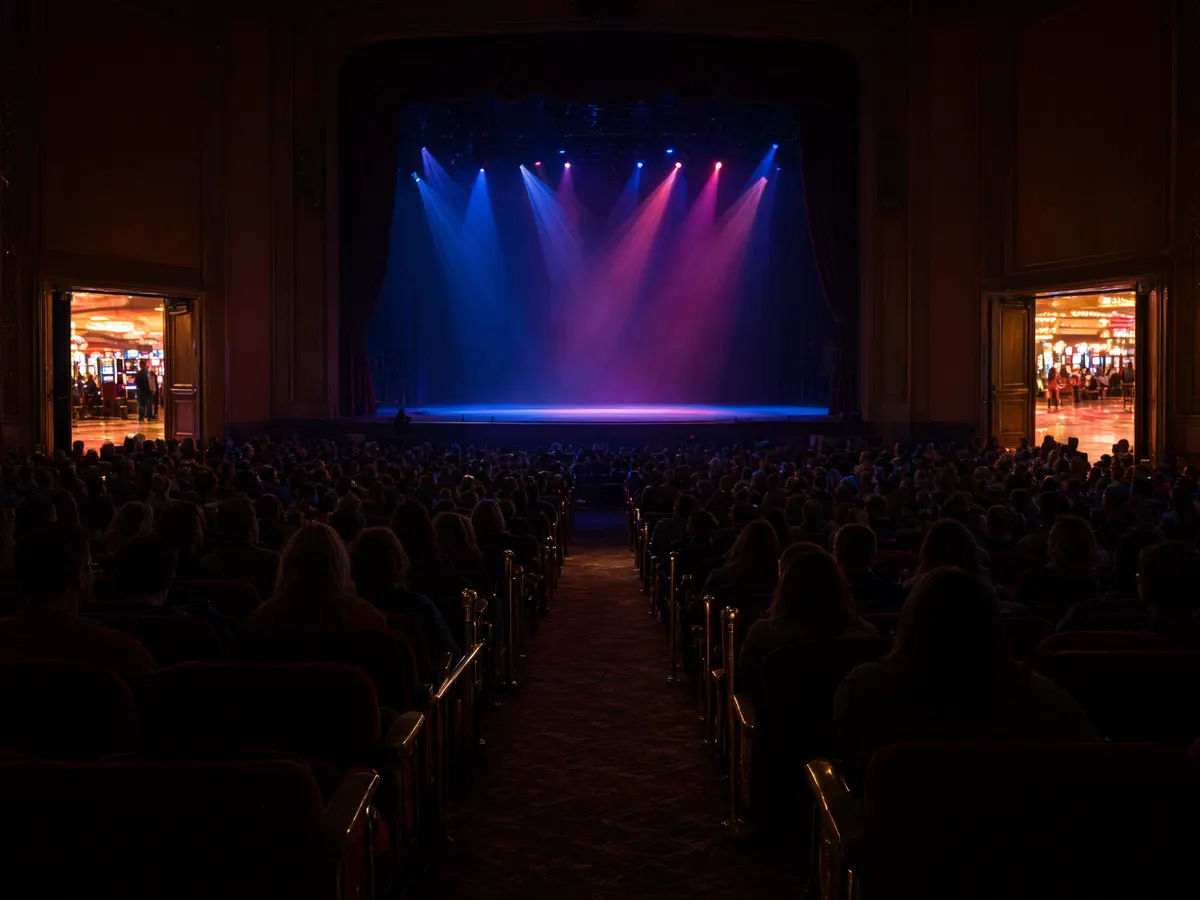
The mechanism is physical. In an integrated resort, the theatre entrance is almost never on the street. You reach it through the casino, and you leave through the casino. Nobody is forced to sit down, but a few thousand people walking a gaming floor twice in one evening, in a good mood, is a different proposition from an empty Tuesday.
The math from the house side is unglamorous and honest. Slot floors on the Strip hold a single-digit percentage of everything wagered, and table games run on fixed edges: 5.26% on double-zero roulette, 2.70% on the single-zero wheel, well under 1% on blackjack against a player using correct basic strategy. None of that changes because a concert is on. What changes is the number of people exposed to it and how long they linger. Volume, not edge, is the variable a residency moves.
Step 3: Follow one patron through the night
Pre-show and post-show patterns
Casino floor traffic around a show has a shape you can almost set a watch by. Doors open an hour or more before curtain, so people arrive early, eat, and kill time. After the show, a crowd of several thousand empties into the property at once, too wired to go to bed. Late-night food, bars and the pit all catch that wave.
Try an illustrative case, because operators think in exactly these terms. A couple arrives three hours before showtime, spends $120 on dinner, puts $300 through a slot machine while waiting, sits through two hours of music, then plays another hour afterwards. If that machine holds around 8% of total wagers over the long run, the house expects to keep roughly $24 from the first session, plus whatever the second produces. Trivial on its own. Multiply by a few thousand attendees across six nights and it stops being trivial.
Two caveats an honest analysis keeps in view. Expected hold is a long-run average, not a per-session forecast, and plenty of patrons never gamble at all. Residency models are built on averages across tens of thousands of admissions, which is precisely why casinos want big rooms and multiple dates rather than one-off concerts.
Extended stay impact
The bigger prize is dwell time measured in days, not hours. A destination act converts a day trip into a two-night stay, or a two-night stay into a long weekend. Every extra night is another room charge, another two or three meals, and another evening in the building with nothing scheduled, which is when the gaming floor does its best work. International fans stretch this further, since someone flying in from Bangkok or Seoul is not booking a single night.
Step 4: Ask who the act actually brings
Demographic targeting in practice
Caesars Palace shows are not booked to please a programming director’s taste. They are booked to reach specific customer segments, and different acts reach very different ones. LISA is the first K-pop artist with a Las Vegas residency, has the largest Instagram following of any K-pop performer at 107 million, and sold out Allegiant Stadium with Blackpink in August 2023 on a gross of over $11.4 million, still the record for a vocal group’s highest-grossing single concert. That booking targets a young, heavily international, digitally native audience that legacy rock residencies do not touch.
Compare that with the rest of the current Vegas board and the strategy becomes obvious.
| Act / residency | Venue | What the booking is built to reach |
|---|---|---|
| LISA, “VIVA LA LISA” | The Colosseum, Caesars Palace | Young global pop and K-pop fans, strong international inbound travel, huge social reach |
| Carlos Santana | House of Blues, Mandalay Bay | Reliable repeat demand from older, higher-frequency visitors; 300-plus shows since May 2012 and now entering a 15th year |
| A Perfect Circle, with The Cult | BleauLive Theater, Fontainebleau Las Vegas | Gen X alt-rock audience for a newer property still building its customer database |
| “Roger Waters Presents Legacy” | The Pearl, Palms | Classic-rock catalogue fans at an off-Strip property competing for locals and value-driven visitors |
Santana’s run is the clearest evidence that the model works. No operator renews a booking for 15 years and 300 shows on sentiment.
Brand positioning benefits
There is a second payoff that never appears on a single night’s P&L. A residency puts the property’s name in every tour announcement, ticket listing, press piece and fan post. When an artist’s audience posts 20 seconds of footage, the venue name travels with it for free. Metallica’s Blood Donation Experience with the American Red Cross at Fashion Show Mall is the same logic applied off-site: the activation earns goodwill and coverage that a paid campaign would struggle to buy.
Step 5: Price the customer, not the ticket
Customer lifetime value
Las Vegas residencies are ultimately a customer acquisition channel, and acquisition is judged on lifetime value. A ticket buyer gives the resort an email, a phone number, a home market and a spending record. Join the loyalty program and the property can also see room spend, dining spend and rated play, which lets marketing calculate what that person is worth over years, not over one weekend.
That is how a show can “lose” money and still be the best line item in the budget. If a run introduces tens of thousands of new names to the database, and a slice of them return twice a year for a decade, the acquisition cost per retained customer looks reasonable next to conventional advertising. It also explains why residencies come in blocks of dates and why successful ones get extended rather than replaced.
Competitive differentiation
Room product across the upper Strip has converged. Suites, pools, steakhouses and sportsbooks all look broadly similar at the top end, and nobody chooses a hotel because of its carpet. Exclusive entertainment is one of the few things a property can own outright. If LISA plays The Colosseum and nowhere else in the United States, Caesars Palace does not have to compete on price for that weekend. It is the only place the demand can go.
Step 6: Measure it the way the finance team does
Live entertainment gaming programs are tracked against the whole property, not the box office. The metrics that matter:
- Incremental occupancy and ADR on show nights versus comparable dark nights
- Gaming revenue per occupied room across the run, and per attendee where players are rated
- Food and beverage covers and average check in the windows before and after curtain
- New loyalty sign-ups attributable to the ticket buyer file
- Repeat visitation from that file over the following 12 to 24 months
- Market share of Strip visitation and non-gaming spend during the residency window
The comparison is always against a counterfactual: what would this Wednesday in November have produced with a dark theatre? If the answer is meaningfully less, the guarantee was money well spent, even when the show itself ran red.
What it means from the other side of the ticket
None of this is a scandal. It is simply worth knowing that the pleasant Friday you have planned, dinner, a show, an hour at a blackjack table, was designed as a sequence, and that every game in the building keeps a fixed mathematical edge over time regardless of who is on stage. Enjoy the concert on its own terms. If you do play, set a budget before you walk in, treat it as the cost of entertainment rather than a way to fund the trip, and use the deposit, loss and time limits that licensed operators are required to offer. Support is available through organisations such as the National Council on Problem Gambling if gambling stops feeling like a night out.
Frequently asked questions
How do casino residencies make money?
Rarely from tickets alone. Revenue arrives through room nights at higher rates, restaurant and bar spend, in-venue drinks and VIP packages, merchandise splits, and increased gaming volume before and after shows. The residency also builds a marketing database the resort monetises for years afterwards.
Why do casinos book expensive shows?
Because an exclusive headline act is one of the few things a competing property cannot copy. It fills rooms on nights that would otherwise be soft, reaches customer segments the resort’s usual marketing misses, and generates coverage and social reach that would cost a fortune to buy outright.
Do residencies increase gambling revenue?
They increase the number of people on the floor and how long they stay, which is what drives gaming revenue since house edges are fixed. A concert cannot change the 5.26% edge on double-zero roulette or a slot floor’s hold percentage, but several thousand extra people passing through twice a night changes the volume those percentages apply to.
Are residency guarantees really that large?
Terms are private, so specific figures for individual deals are rarely confirmed publicly. What is visible is the scale of the commitment: multi-night blocks in purpose-built theatres, custom production, and global marketing. The willingness to keep renewing, as with Santana’s 15th year at House of Blues, tells you more about the economics than any leaked number.