Casino tourism transport, defined in one line, then complicated
Casino tourism transport is the plumbing that moves discretionary spenders to a gaming floor: highways, airport gates, charter buses, and occasionally trains. Simple enough. The complication is that a huge share of that plumbing exists only as a rendering, a groundbreaking photo, and a financing plan that hasn’t closed.
Brightline is the current case study. Brightline Holdings and roughly 16 affiliated Florida parent companies have filed for Chapter 11 protection in New Jersey, entering a restructuring support agreement with existing investors to put another $490 million into the Miami-to-Orlando railroad. That filing does not directly touch the Las Vegas project, and a company spokesperson told the Las Vegas Review-Journal it has “no bearing” on it. Fine. But the Vegas line’s real problem was already visible without any bankruptcy court: nothing much has been built.
What filed, what didn’t, and why the distinction is thinner than it looks
Three entities, three different situations, and the press coverage blurs them constantly.
- Brightline Holdings and its affiliates filed for Chapter 11. This is the Florida parent structure, Fortress-backed.
- Brightline Trains Florida, the company that actually operates the Miami–Orlando service, did not file. Those trains keep running.
- Brightline West, the Las Vegas–Southern California project, is a separate legal entity with overlapping ownership rather than a wholly owned subsidiary of the Florida railroad. Legally insulated. Reputationally, not remotely.
The legal separation is real, and it matters to creditors. It matters far less to the lenders and bond buyers Brightline West still needs, because they are being asked to fund a much bigger, harder, more expensive railroad by the same sponsor whose first railroad just went into restructuring. Capital markets price stories, and this story got worse.
The numbers that make this a gaming story, not just a finance story
Here is the project as it currently stands, per Brightline West’s own plans and federal project documents.
| Item | Detail |
|---|---|
| Route | Las Vegas Boulevard station site (between Blue Diamond and Warm Springs roads) to Rancho Cucamonga, California |
| Distance | 218 miles, largely in the median of Interstate 15 |
| Top speed / journey time | Up to 200 mph, about two hours end to end |
| Intermediate stations | Hesperia and the Victor Valley, plus a possible stop at the Southern Nevada Supplemental Airport near Jean, which Clark County hopes to open between 2035 and 2037 |
| Los Angeles connection | Transfer to Metrolink at Rancho Cucamonga |
| Original completion target | In time for the 2028 Olympic Games in Los Angeles |
| Current completion target | Late 2029 |
| Cost estimate | Roughly $12.4 billion, revised to $21.05 billion |
| Federal support | $3 billion federal award |
| Groundbreaking | Ceremonial, April 2024 |
| Las Vegas terminus site work | Began 2025 on about 110 acres: grading, sewer and storm drain work, start of a parking garage; activity now appears stalled |
| Heavy construction | Track laying in the I-15 median across the Mojave has not begun |
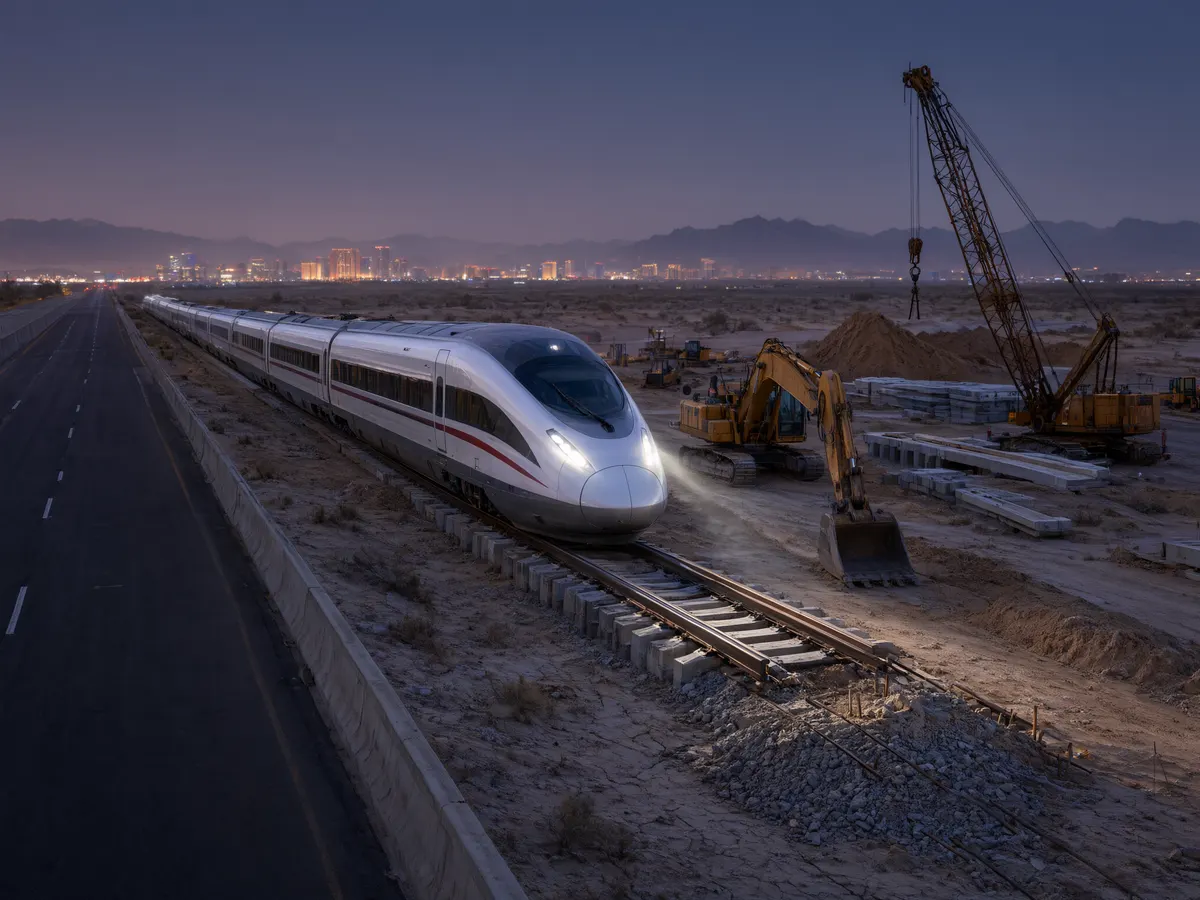
Read that table as a gaming analyst rather than a rail fan. A two-hour, 200 mph link from the Strip to the edge of the Los Angeles basin would have changed the shape of the Las Vegas customer: more weekend trips, more spontaneous ones, fewer four-hour-plus I-15 slogs on a Sunday afternoon, and a plausible market for people who currently decide the drive isn’t worth it. That is the single biggest potential change to Las Vegas demand since low-cost carriers. It is also, right now, a parking garage nobody has worked on in at least six months.
How to audit a casino-destination transport promise before you price it in
If you follow gaming stocks, regional competition, or just plan trips, this is the checklist I use. It would have flagged Brightline West well before the Chapter 11 headlines.
- Separate the entity from the brand. Ask which legal entity holds the project, who owns it, and whether the operating company shares a balance sheet with the parent. “No bearing” can be technically accurate and still tell you nothing about the money.
- Check whether heavy construction has started. Grading, utilities, and a parking structure are site prep. Track in the median across 218 miles of desert is the project. Until the hard part begins, the schedule is an intention.
- Follow the cost curve, not the announcement. A jump from about $12.4 billion to $21.05 billion is not a rounding error. It changes the debt load, the required fare box, and the ridership assumptions the whole thing rests on.
- Find the anchor event, then watch it slip. The line was pitched for the 2028 Olympics in Los Angeles. That date was gone before the bankruptcy filing. When a project loses its marketing anchor, the urgency that attracted political and private money goes with it.
- Interrogate the last mile. Rancho Cucamonga is not Los Angeles. Riders transfer to Metrolink. Every transfer, shuttle, and rideshare queue between the platform and the casino floor shaves conversion off the projected visitor.
- Count who the stations actually serve. Hesperia and the Victor Valley are commuter-flavoured stops. A possible station at an airport that might open in the mid-2030s is not a 2029 asset. Gaming demand needs the Strip terminus and the SoCal terminus working together, on day one.
The practical read-through for gaming operators and online play
Southern California has long been Las Vegas’s largest drive-in feeder market, and it stays a drive-in market for the foreseeable future. Everything that follows from that is unchanged: I-15 traffic still caps weekend throughput, holiday congestion still suppresses Sunday night trips, and fuel prices still act as a soft tax on the mid-tier Vegas customer. Operators who built forecasts around a 2028 or 2029 rail bump should treat that bump as unfunded until track goes down.
There is a second-order effect that matters more to this audience. When travel friction to a destination stays high, the spend does not evaporate; it relocates. Some of it goes to nearer-to-home casinos, including California’s tribal properties. Some of it moves to phones. California still has no legal online casino or regulated online sportsbook, which means the digital share of that demand largely lands in sweepstakes-style social casinos, daily fantasy products, and offshore sites operating outside state oversight. Anyone arguing about the size of the unregulated market in the country’s biggest state should note that transport friction is quietly one of its inputs.
For Nevada operators, the tactical response is the familiar one: lean on air access and the event calendar. Big-event weekends, Formula 1, marquee fights, and conference traffic do the work rail was supposed to do, but only in bursts, and they concentrate demand into the weekends that were already full. Rail would have widened the base. Air and events sharpen the peaks. They are not substitutes.
And for readers who bet: a delayed railroad is a reminder that infrastructure timelines are among the least reliable numbers in gaming. Treat “late 2029” the way you’d treat any long-dated projection, as a scenario with a wide distribution, not a date. If you’re gambling on anything, online or on a floor, set deposit and time limits first and keep it inside money you can lose. Support is available through national helplines if it stops being fun.
Common questions
Does the Chapter 11 filing kill the Las Vegas to Los Angeles train?
No. Brightline West is a separate legal entity and the company says the Florida filing has no bearing on it, with its focus on completing financing. What the filing does is make that financing harder to sell, at a moment when heavy construction still hasn’t started.
When could the line realistically open?
Brightline West’s stated target is late 2029, down from an original ambition of being ready for the 2028 Olympics in Los Angeles. Since track laying in the I-15 median has not begun and the Las Vegas terminus site appears stalled, treat late 2029 as the optimistic end of the range.
How much has the project’s cost changed?
The estimate has gone from roughly $12.4 billion to $21.05 billion, according to federal project documents and subsequent reporting. A $3 billion federal award is committed, which leaves a very large private financing gap.
Would the train actually reach Los Angeles?
Not directly. The western terminus is Rancho Cucamonga, where riders transfer to Metrolink for Los Angeles. For a Vegas-bound gambler, that transfer is part of the real trip time, and part of the reason some travellers would still choose to drive.