
The block trade that explains the hire
In June, two counterparties settled a six-figure block trade on Polymarket. The underlying wasn’t a presidential race or a Premier League fixture. It was GPU compute, the hardware at the centre of the AI buildout. No retail punter places that trade. That single transaction tells you more about prediction market institutional growth than any billboard campaign does, and it explains why Polymarket has now hired a former Goldman Sachs partner to chase the money that placed it.
Polymarket announced Lisa Mantil as head of institutional growth. Her remit is everything that isn’t retail: banks, corporate treasuries, fund managers and trading firms. Staff moves at exchanges are usually noise. This one is signal, and the reason sits in her CV rather than her job title.
Who Lisa Mantil is, and why the ETF background matters
Mantil spent close to three decades at Goldman Sachs, the largest US investment bank, becoming a partner in 2018. Most recently she ran the bank’s ETF Accelerator, a platform built to help asset managers launch new exchange-traded funds.
Read that last line twice. Polymarket did not hire a crypto growth marketer or a sportsbook trading boss. It hired someone whose day job was taking financial products through the plumbing that institutions insist on before they will allocate: legal wrappers, market-maker relationships, listing mechanics, compliance sign-off. That is a deliberate choice about what Polymarket thinks it is becoming.
The company framed the appointment around hedging rather than speculation. Institutions, its statement argued, have historically relied on proxies and correlated assets to express a view on an event, with no guarantee those instruments actually move in line with the risk they are meant to offset. Direct event contracts, the pitch goes, close that gap.
What are prediction markets, exactly?
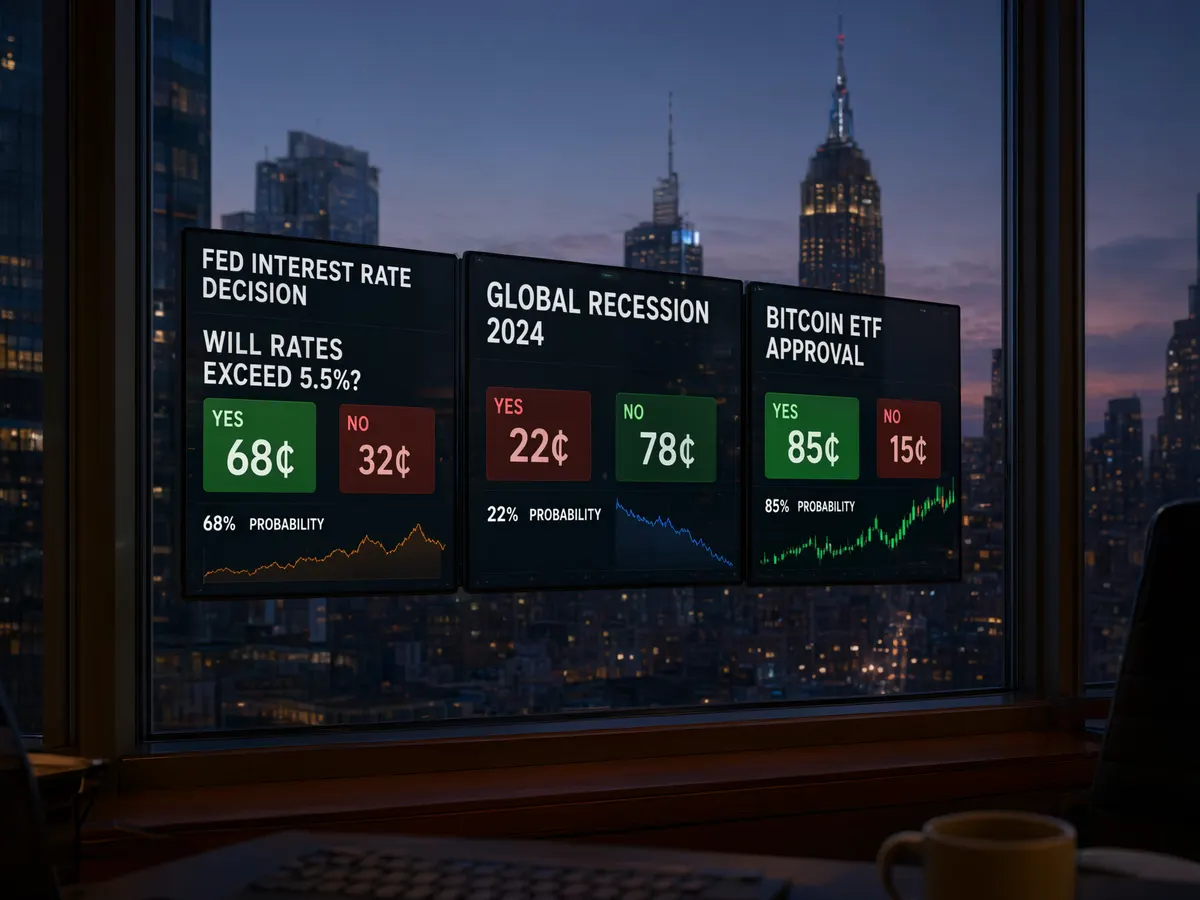
A prediction market is an exchange where you trade contracts on the outcome of a real-world event. Each contract settles at a fixed value if the event happens and at zero if it doesn’t, so the live price reads as a probability. A contract trading at 63 cents implies roughly a 63% market-assessed chance.
Polymarket explained in one sentence: it is a yes/no exchange where users buy and sell shares in defined outcomes, and the price is set by order flow rather than by a bookmaker’s odds compiler.
How a market resolves
Every market needs three things to function: an unambiguous question, a resolution date, and a resolution source. “Will X happen by 31 December” is tradeable. “Will the economy do well” is not. When the event resolves, winning contracts pay the full settlement value and losing contracts expire worthless. Traders can also sell out before resolution at whatever the market will pay, which is the part that makes it behave like a market and not a bet slip.
Where the liquidity and pricing come from
This is the structural difference from a sportsbook, and it is the whole ballgame for institutional adoption. A bookmaker sets a price, takes the other side, and builds in a margin. An exchange matches you against another participant and takes a fee or earns the spread. Prices move because someone is willing to pay up, not because a risk manager shaded a line.
That model lives or dies on liquidity. Thin books mean wide spreads, bad fills and prices that mean very little. Hence the wider arms race: Coinbase and CMCC backed prediction market liquidity provider Raven at a $90m valuation, and professional market makers are being courted precisely because institutional-size orders need someone standing ready to absorb them.
Worth stating plainly: no market structure removes cost. Fees and the bid-ask spread are the drag here, the same way the house edge is the drag in casino games. Being on an exchange rather than against a bookmaker changes who you are trading against, not the fact that most participants lose money to costs and to better-informed counterparties over time.
Myth: institutions want to gamble. Reality: they want a hedge that doesn’t exist yet
The lazy reading of this hire is that Wall Street has spotted a hot gambling product and wants a cut. Call it institutional gambling and move on. That reading is wrong, or at least incomplete, and the GPU block trade is the counter-evidence.
A corporate whose capex plan depends on AI hardware availability has no clean instrument to hedge that exposure. It can trade semiconductor equities and hope the correlation holds. It can buy options on something adjacent. Both are proxies, and proxies break at exactly the moment you need them. An event contract on the specific outcome is a direct hedge on a specific risk. That is the same logic that built the weather derivatives market and the credit default swap market: someone had an exposure nobody would price, so a market got built around it.
Three forces are pushing capital in now:
- Valuations demanding a bigger story. Donald Trump Jr’s firm put a further $300m into Polymarket. Money at that scale is not underwriting a retail betting app; it expects new use cases and a less retail-dependent revenue base.
- Product wrappers arriving. Tema ETFs launched the first prediction market ETF. Once an exposure can be wrapped, allocators who cannot open an exchange account can still get exposure.
- Infrastructure being bought, not hoped for. Dedicated institutional platforms, block trade capability and a research arm are the unglamorous prerequisites. Polymarket launched Polymarket Institutional Research in July, describing it as a publication on the intersection of its markets and the global financial system.
For anyone approaching prediction markets investing as an emerging asset class, the honest comparison is early-stage derivatives markets: real economic utility, poor liquidity outside a handful of contracts, and unsettled regulation.
Institutional vs retail: one order book, two different products
A retail user opens an app, clicks yes on an election market and stakes $50. An institution cannot do that, and not because it lacks conviction. It lacks permission. Its mandate, auditors and risk committee all need answers the crypto-native model was never built to give.
| Requirement | Crypto-native retail user | Institutional participant |
|---|---|---|
| Typical order size | Small, on-screen | Large enough to move a thin book; needs block execution |
| Motive | Speculation, opinion, entertainment | Hedging a defined exposure, relative-value trading |
| Onboarding | Wallet connection, basic verification | Full KYC/AML on the entity, counterparty due diligence |
| Settlement | Stablecoin balance | Documented custody, auditable settlement trail |
| Reporting | Trade history in-app | Mark-to-market valuations, compliance and audit reporting |
| Liquidity tolerance | Accepts wide spreads | Needs committed market makers and depth at size |
Mantil’s hire is best understood as a translation job. Somebody has to convert “yes/no exchange with a stablecoin balance” into language a bank’s risk committee will approve. Nearly thirty years inside Goldman is exactly that credential.
The legal cloud nobody mentions at the launch party
Here is the uncomfortable part. Most volume on yes/no exchanges today comes from sports event contracts, and their legal status in the US is genuinely unsettled. Analysts at Jefferies have flagged that the Supreme Court could take up a prediction markets case in a window running from November to June, and some legal specialists think a ruling could bar or sharply limit sports derivatives.
Strip out sports and a large slice of current revenue goes with it. That is the strategic reason the institutional push is urgent rather than opportunistic. Financial, macro and commercial event contracts sit more comfortably inside the derivatives framework that US regulators already oversee, and they attract a client base that doesn’t evaporate if one product line is restricted. Diversification here is defensive.
What it signals for event betting platforms
Three consequences follow, and they matter well beyond Polymarket.
The competitive axis shifts. Event betting platforms have been competing on app polish, market breadth and sports coverage. Institutional clients don’t care about any of that. They care about execution quality, counterparty comfort and reporting. That is a far more expensive game, and it favours operators with capital and hiring credibility over fast-moving startups.
Legitimacy cuts both ways. Hiring from Goldman buys credibility with allocators and, simultaneously, invites sharper scrutiny. A venue used by banks and fund managers to hedge live exposures will be held to standards that a novelty crypto app never was, from market surveillance to how resolution disputes get handled. Every operator courting institutions should expect its resolution process to be examined line by line.
The category definition is being fought over right now. Are these gambling products with a financial veneer, or derivatives with a consumer interface? The answer determines licensing, tax treatment and who gets to distribute them. Polymarket has cast its vote by hiring the person who used to launch ETFs.
Whether the market clears that bar is an open question. Event contracts remain thinly traded outside a few headline markets, and a hedge that cannot be exited at a fair price is not much of a hedge. But the direction of travel is no longer ambiguous.
Frequently asked questions
How does Polymarket work?
You buy or sell contracts on a defined outcome. Prices sit between zero and the full settlement value and read as implied probabilities. Winning contracts pay out at resolution; losing ones expire at zero. You can also close a position before resolution by trading out at the prevailing market price.
Why does institutional money matter here?
It brings depth. Bigger, more consistent order flow narrows spreads and makes prices more informative, which is what turns an event market into something usable as a hedging tool rather than a curiosity.
How does this compare with traditional derivatives markets?
The economic logic is the same as any derivative: transfer a specific risk to someone willing to price it. The differences are scale, standardisation and regulatory maturity. Listed futures and options have decades of clearing infrastructure and settled rules behind them. Event contracts are building all of that in public.
Does an institutional push make these markets safer for individuals?
Better liquidity and tighter pricing help everyone, but they don’t change the arithmetic of trading against better-resourced participants. Anyone taking positions on event outcomes should treat it as risk capital, set limits before opening a position, and use the deposit and loss limits or self-exclusion tools the platform offers. If it stops feeling like a decision and starts feeling like a compulsion, step away and seek support.