
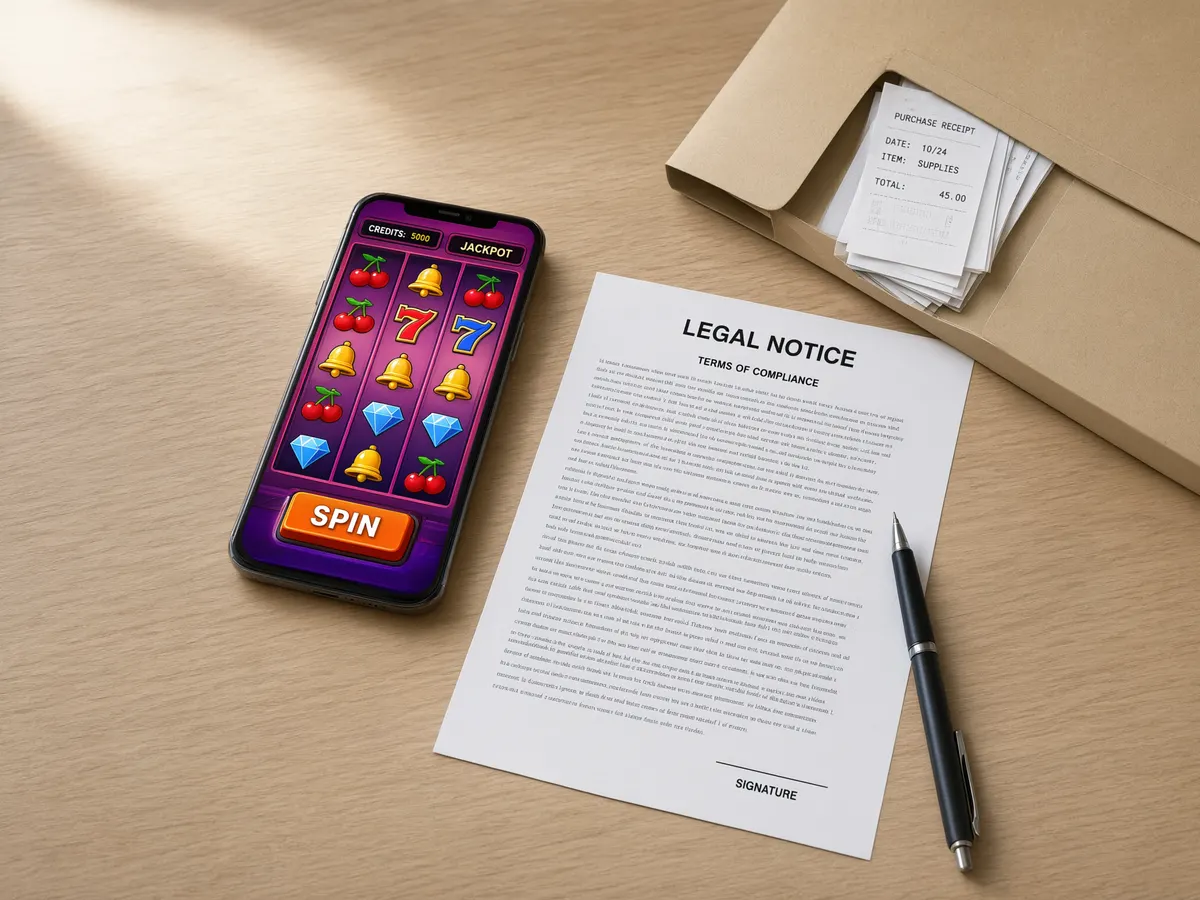
Spent real money on virtual chips in a free-to-play slots app and wondered whether any of it is recoverable? In a handful of US states, some of it may be, though not through the app’s support inbox. A social casino app refund of this kind comes from a court settlement, and the only way to get one is to file a claim before a published deadline.
The clearest recent example: social casino developer Playstudios agreed to a $3.2 million settlement resolving a class action over virtual currency sales in six states. The company denied all the claims and settled to avoid further litigation. That single sentence captures how nearly all of these refunds work. Nobody admits anything, money goes into a fund, and people who spent cash in the right app, in the right state, during the right window can ask for a share.
What a social casino app refund actually is
It is compensation paid out of a legal settlement fund, not a customer service gesture. Two things separate it from a normal app store refund.
First, the route. An ordinary in app purchase refund is requested from Apple or Google, usually within a short window after the charge, and it is granted at the platform’s discretion for reasons like accidental purchases or a broken app. A settlement refund is administered by a court-approved claims administrator, covers purchases made years earlier, and follows criteria set out in a legal notice.
Second, the trade. Accepting benefits from a class action settlement normally means giving up your right to sue that company over the same issue later. In the Playstudios settlement, class members who take part forfeit future claims on the matter, while those who formally exclude themselves get nothing from the fund but keep the right to bring their own case.
One more distinction worth nailing down, because the two categories get muddled constantly. Social casino apps are free-to-play, hand out daily credits, and sell tokens so you can keep playing once those credits run out. Those tokens have no cash value and never pay out. Sweepstakes casinos run a dual-currency model where a secondary currency can, under their rules, be redeemed for prizes. A sweepstakes casino claim and a social casino claim can look similar on paper, but they turn on different legal questions. Read the notice, not the headline.
Why the lawsuits exist in the first place
The core argument in a social casino lawsuit is that selling virtual coins to extend play inside a slot-style game amounts to gambling under a particular state’s law, even though the coins can never be cashed out. Plaintiffs typically frame the purchase of premium currency as something of value staked on a game of chance, and point to state statutes that let players recover gambling losses.
In White, et al. v. Playstudios, filed in Alabama’s Franklin County Circuit Court, the allegation was that Playstudios violated state gambling laws by selling virtual currency that let players continue playing after their free credits ran dry. The company asked the court to dismiss the case, arguing its apps are legal, free social entertainment rather than gambling systems. It later agreed to settle while denying the claims.
Other cases in this space lean on consumer protection theories instead: that the freemium model, the odds presented, or the terms of service create a misleading impression of what a player is buying. The legal theory matters to you for one practical reason. It determines which states are covered and which purchase dates count, because the relevant statute and its lookback period are state specific.
Player refund eligibility requirements
Eligibility is defined by the settlement itself, not by how much you feel you lost. Broadly, the criteria fall into four buckets:
- You paid money. Free play, ad-watching and gifted coins do not count. Claims are built on actual in-app purchases.
- You played a listed app. Settlement notices name specific titles. The Playstudios settlement covers myVEGAS, myVEGAS Facebook, myVEGAS Mobile, Pop! Slots, myKONAMI Slots, MGM Slots Live, myVEGAS Blackjack and myVEGAS Bingo.
- You were in a covered state. That settlement class includes people in Alabama, Ohio, New Jersey, Massachusetts, Tennessee and Kentucky. Residents of other states are simply outside the class.
- Your purchases fall inside the date window. These vary by state, sometimes by years.
The date ranges from the Playstudios settlement notice show how uneven player refund eligibility can be across a single case:
| State | Qualifying purchase period |
|---|---|
| Alabama | March 8, 2022 – June 30, 2026 |
| Ohio | July 26, 2022 – June 30, 2026 |
| New Jersey | January 2, 2024 – June 30, 2026 |
| Massachusetts | July 26, 2022 – June 30, 2026 |
| Tennessee | November 12, 2022 – June 30, 2026 |
| Kentucky | July 5, 2018 – June 29, 2023 |
Kentucky’s window opens years earlier and closes years sooner than New Jersey’s. There is no pattern to intuit here. The only reliable source is the official notice for the specific case.
How a social casino refund claim works
The process is bureaucratic rather than adversarial. You are not suing anyone, you are filling in a form.
- Notice goes out. Once a court preliminarily approves a settlement, the administrator notifies the class by email, in-app message, mail or a public notice campaign, and publishes a dedicated settlement website.
- You choose how to respond. Typically you can file a claim or election form, do nothing, or formally exclude yourself. Each option has consequences. In the Playstudios settlement, the election form asks whether you want benefits as payment, virtual currency, or both; class members who file nothing receive virtual currency by default.
- You submit before the deadline. Forms are usually accepted online and by mail. The Playstudios notice set October 21, 2026 as the deadline for election forms.
- The administrator validates claims. Purchase records are checked against the company’s own transaction data, which is why the data the developer holds often matters more than what you can dig up.
- Final approval, then payment. A court holds a fairness hearing, and payment only follows final approval, plus any appeal period.
Filing is free. Class action participation does not require hiring a lawyer, and legitimate administrators never ask claimants for an upfront fee. Anyone charging you to “unlock” a settlement payout is running a different kind of operation entirely.
Documentation worth gathering before you file
Most forms ask for basic identifying details, your in-app username or account email, and the state where you played. Supporting records help when the administrator’s data is incomplete or your purchases were spread across devices.
- App store purchase history. On Apple devices this lives in your Apple Account purchase history; on Android it is in Google Play’s order history. Both keep records well beyond a year, and both can be exported or emailed to you.
- Email receipts. Search your inbox for the app name plus terms like receipt, invoice or order. Platform receipts are usually itemised down to the coin pack.
- Card and bank statements. Useful for totalling spend across long periods, though the merchant line often reads as the platform rather than the game.
- In-app account details. Player ID, registered email, and the approximate date you started playing.
- The notice itself. Keep the claim number or class member ID if one was issued to you.
A word of caution on the paperwork: forms carry certification language, and misstating your state of residence or purchase totals to qualify is fraud. Not worth it for a share of a fund.
What these claims realistically deliver
Set expectations low and you will rarely be disappointed. A settlement fund is a fixed pot divided among everyone who files, after fees and administration costs approved by the court. The more valid claims, the thinner the slice. Payments in consumer class actions frequently land well below what a heavy spender actually spent, and in cases like this one part of the benefit may arrive as virtual currency rather than cash, which is worth exactly as much as you value more chips.
Timelines run long. Months between filing and payment is normal, and appeals can stretch that further. Nor is any settlement guaranteed to survive; courts can reject terms they consider unfair to the class.
The two decisions that actually matter are whether to file at all and whether to opt out. Filing costs you a few minutes and your future claims on that issue. Opting out preserves your legal options but leaves you with nothing from the fund, and pursuing an individual case is its own project. If your spend was substantial, that is a conversation for a lawyer licensed in your state.
This article is educational and is not legal advice. Settlement terms, deadlines and eligibility change, and only the official court-approved notice for a given case is authoritative. If you are looking at your purchase history and the totals are larger than you remember, that is worth sitting with. Social casino apps are designed to keep play going, spending caps and app-level purchase restrictions exist for a reason, and support is available through services such as the National Council on Problem Gambling.
Common questions
How do I get a refund from a social casino app?
Two separate routes. For a recent or accidental charge, request a refund from Apple or Google through their purchase history tools. For purchases covered by a legal settlement, file the claim or election form on the official settlement website before the stated deadline. Contacting the app developer directly rarely produces a refund for ordinary gameplay spending.
What qualifies for a social casino refund?
Paid in-app purchases in a named app, made while in a covered state, within the qualifying date range set by the settlement. Free credits, promotional coins and play in non-covered states do not qualify.
Which social casino apps have lawsuits?
Claims have been brought against several social casino operators over virtual currency sales. The publicly documented example here is White, et al. v. Playstudios, which covers myVEGAS, Pop! Slots, myKONAMI Slots, MGM Slots Live, myVEGAS Blackjack and myVEGAS Bingo. Check current court records or an official settlement site rather than relying on secondhand lists.