A prediction market is an exchange where you buy and sell shares in whether something happens. Simple enough, until you ask the awkward question: who is on the other side of your trade at 3am when nobody else wants that contract?
That question is the entire business. And it explains why Raven, a firm most retail traders have never heard of, just raised money at a $90 million valuation from Coinbase Ventures and CMCC Global. Raven doesn’t run a prediction market. It supplies prediction market liquidity, which is the plumbing that makes the whole thing tradeable.
Why did Coinbase just back a market maker at a $90M valuation?
Raven closed a financing round led by Coinbase Ventures and CMCC Global that values the firm at $90 million pre-money. The two investors didn’t disclose how much they put in. CMCC co-founder Charlie Morris is joining Raven’s board.
The interesting number is the trajectory. Raven was valued at $25 million after a $2.7 million seed round in 2024 led by Hack VC, with Wintermute Ventures among the participants. So the valuation has more than tripled in roughly a year and a half.
Raven was founded in 2023 and describes itself as an algorithmic high-frequency trading firm. It only entered event contracts in the second quarter of 2025 and says it has since made markets in thousands of them. It also provides liquidity for digital assets and token projects across centralised and decentralised venues, plus traditional financial assets.
For Coinbase Ventures this is not a one-off. Its portfolio already includes Billy Bets, an autonomous AI agent that trades sports event contracts on platforms such as Polymarket; Earlybird, a market for trading outcomes tied to privately held companies; and Limitless, one of the larger prediction markets operating outside the United States. A crypto exchange betting on the infrastructure layer of event contracts is a fairly clear statement about where it thinks volume is going.
What is a prediction market?
A prediction market is a venue where participants trade contracts that pay a fixed amount if a stated event happens and nothing if it doesn’t. Prices move with supply and demand, so the current price of a “Yes” share works as a live estimate of probability.
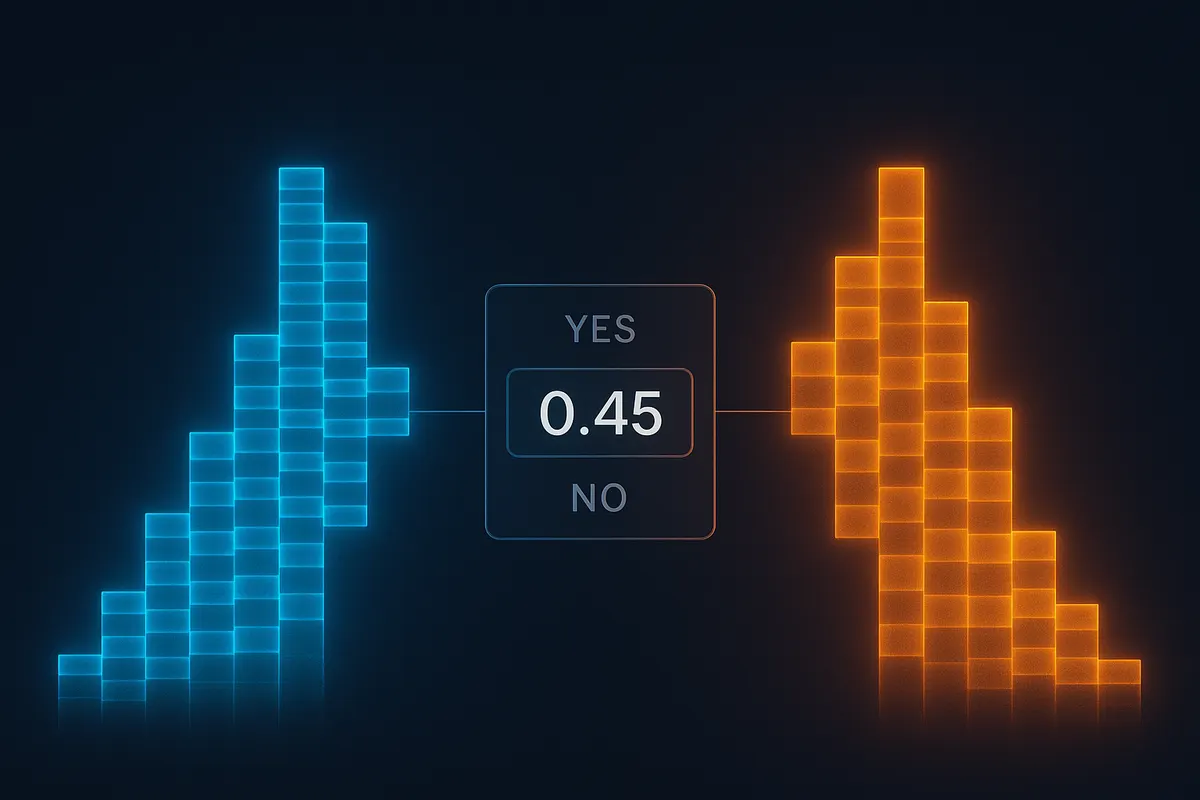
The usual convention: a contract settles at $1 if the event occurs and $0 if it doesn’t. If “Yes” trades at $0.45, the market is pricing roughly a 45% chance. Buy it at $0.45 and you risk 45 cents to make 55 cents. Buy “No” at $0.55 and the arithmetic mirrors it.
How do prediction markets set odds?
They don’t set them. That’s the philosophical difference from a sportsbook, and it matters more than most explainers admit.
In a prediction market, the price is whatever the last trade cleared at, with an order book of resting bids and asks around it. No compliance team writes the line. If a trader thinks 45% is too low, they buy until the price rises. The “odds” are a consensus that updates every time real money moves.
Converting between the two worlds is straightforward. A $0.45 contract equals implied probability of 45%, which is decimal odds of about 2.22 (1 ÷ 0.45). That makes prediction market prices directly comparable to bookmaker prices, which is exactly why sharper bettors watch them.
What do people actually trade beyond politics?
Elections got prediction markets their headlines, but they are a small slice of listed contracts now. Typical categories include:
- Sports outcomes, traded as event contracts rather than fixed-odds bets
- Macroeconomic data: interest rate decisions, inflation prints, jobs numbers
- Crypto and equity price thresholds by a given date
- Corporate events, including the kind of private-company outcomes Earlybird lists
- Awards, entertainment results and scheduled announcements
The common thread is a question with a verifiable, dated answer. If an outcome can’t be settled objectively, it can’t be a contract.
How do prediction markets differ from a traditional sportsbook?
The short version: a sportsbook is your counterparty, a prediction market is your marketplace. With a bookmaker, the house takes the other side of your bet and prices in a margin. On an exchange, another participant takes the other side and the platform earns fees.
Work through the margin honestly. A two-way sportsbook market priced 1.90 / 1.90 implies 52.6% on each side, totalling 105.3%. That 5.3% overround is the house edge baked into the price. On a prediction market, if “Yes” is offered at $0.45 and “No” at $0.57, the two sides sum to $1.02, so the round-trip cost of crossing the spread is about 2%, plus whatever trading or settlement fee the venue charges.
Cheaper is not the same as free, and it is certainly not the same as profitable. You still pay the spread, you still pay fees, and you are now trading against professional firms with better models and faster execution than you. The edge simply moves from the house to the sharpest participants.
| Feature | Traditional sportsbook | Prediction market |
|---|---|---|
| Counterparty | The operator | Another trader, often a market maker |
| Price source | Bookmaker-set lines | Order book, set by trades |
| Operator revenue | Built-in margin (overround) | Trading and settlement fees |
| Cost to the participant | House edge in the odds | Bid-ask spread plus fees |
| Exit before the event | Cash-out at operator’s price, if offered | Sell your position at market price |
| Transparency | Final prices only | Visible book, depth and trade history |
| Winner limits | Accounts can be limited or closed | Volume is generally welcome |
What is market liquidity, and why do thin markets fail?
Liquidity is the ability to buy or sell a meaningful size quickly without moving the price much. Market depth is how much size is resting near the current price. The bid-ask spread is the gap between the best buy and best sell order. Tight spread plus real depth equals a liquid market.
Now picture the opposite. A contract on a minor event shows a bid of $0.30 and an ask of $0.62. The “probability” is somewhere in a 32-cent fog. You want to put ₹10,000 on Yes, but only ₹800 is available at the ask, so your order walks up the book and your average fill is $0.71. Your position is underwater the instant it’s filled, and if you change your mind an hour later, the only bid is $0.30.
Three things break at once in a thin market. Prices stop being honest signals of probability. Participants can’t get in or out at a fair level. And nobody can trust the number, so nobody arrives, which keeps the market thin. Gemini’s Cryptopedia puts the same point plainly in its explainer on market makers: without them, prediction markets would be illiquid, slow and inaccurate, because participants would have to wait around to find a counterparty.
How do liquidity providers make money?
A liquidity provider quotes both sides at once. It posts a bid a little below its own fair-value estimate and an ask a little above, then repeats that across thousands of contracts. When someone hits the bid and someone else takes the ask, the firm has bought low and sold high on the same contract and pocketed the difference.
That difference is the spread, and it is small: fractions of a cent per contract in busy markets. The model only works at volume, with tight inventory control, which is why the firms doing it are high-frequency trading shops rather than betting syndicates. Raven’s own description of itself as an algorithmic HFT firm is the tell.
Automated versus manual market making
There are two broad approaches, and serious venues use both.
An automated market maker (AMM) is a formula holding both sides of a pool. Price adjusts mechanically as shares are bought or sold, so a market can launch with no traders at all. That solves the cold-start problem and it is why decentralised betting venues lean on AMMs. The cost is precision: a formula doesn’t know that a player just got injured.
Professional market makers quote from models and news, adjusting continuously and hedging exposure elsewhere, sometimes on related contracts or in traditional markets. They are slower to launch a market and far better at keeping it accurate once it’s live. Competition between several such firms is what actually grinds spreads down over time.
Where the revenue comes from, and the risk attached
Spread capture is the core. On top of that, liquidity providers often receive rebates or fee discounts from venues that need depth, and some are paid directly to make markets in newly listed contracts.
The risk is adverse selection. If you are quoting both sides of a contract and someone trades against you because they know something you don’t, you lose. Prediction markets are full of information events, so a provider that misprices a book can be run over quickly. Market making is not a fee-collection machine; it’s a balance-sheet business with real losses.
Does Raven’s round mean prediction markets are maturing?
It suggests the infrastructure is being priced as a business rather than an experiment. Investors don’t triple the valuation of a market maker because they like the narrative. They do it because they expect volume, and volume on an exchange is worth more to a liquidity provider than to almost anyone else.
The wider pattern is consistent: institutional money is flowing into venues and into the firms that quote them, including reported nine-figure investments in Polymarket, alongside Coinbase Ventures’ string of smaller bets on Billy Bets, Earlybird and Limitless. Meanwhile the regulatory picture, at least in the United States, has become clearer around exchange-traded event contracts than it was a few years ago, which makes capital commitments easier to justify.
Where crypto betting platforms fit in is less settled. On-chain venues get the transparency and the global reach; they also inherit wallet friction, gas costs and a patchwork of geoblocks. Availability varies enormously by country, and several major venues simply refuse entire jurisdictions.
So should you be trading event contracts?
Understand what you’re walking into. Peer-to-peer wagering removes the bookmaker’s margin, but it hands you a market where firms like Raven quote prices for a living. You are not escaping the edge, you are choosing a different counterparty, and a better-informed one. Lower transaction costs mean nothing if your probability estimates are worse than the market’s.
Two practical points before anything else. Check whether a platform is legally available where you live; real-money online gaming rules differ sharply by jurisdiction and several countries are tightening rather than loosening. And treat prices as estimates, not guarantees, because a contract trading at $0.90 still loses one time in ten by its own maths.
Anything staked on an uncertain outcome is gambling, whatever it’s called on the interface. Risk only money you can lose without consequence, set deposit and loss limits before you start, and if it stops feeling like a considered decision, use the venue’s cool-off or self-exclusion tools. Our responsible gambling guide covers those tools in more detail, and if you’re new to on-chain venues, start with our crypto betting explainer before funding a wallet.