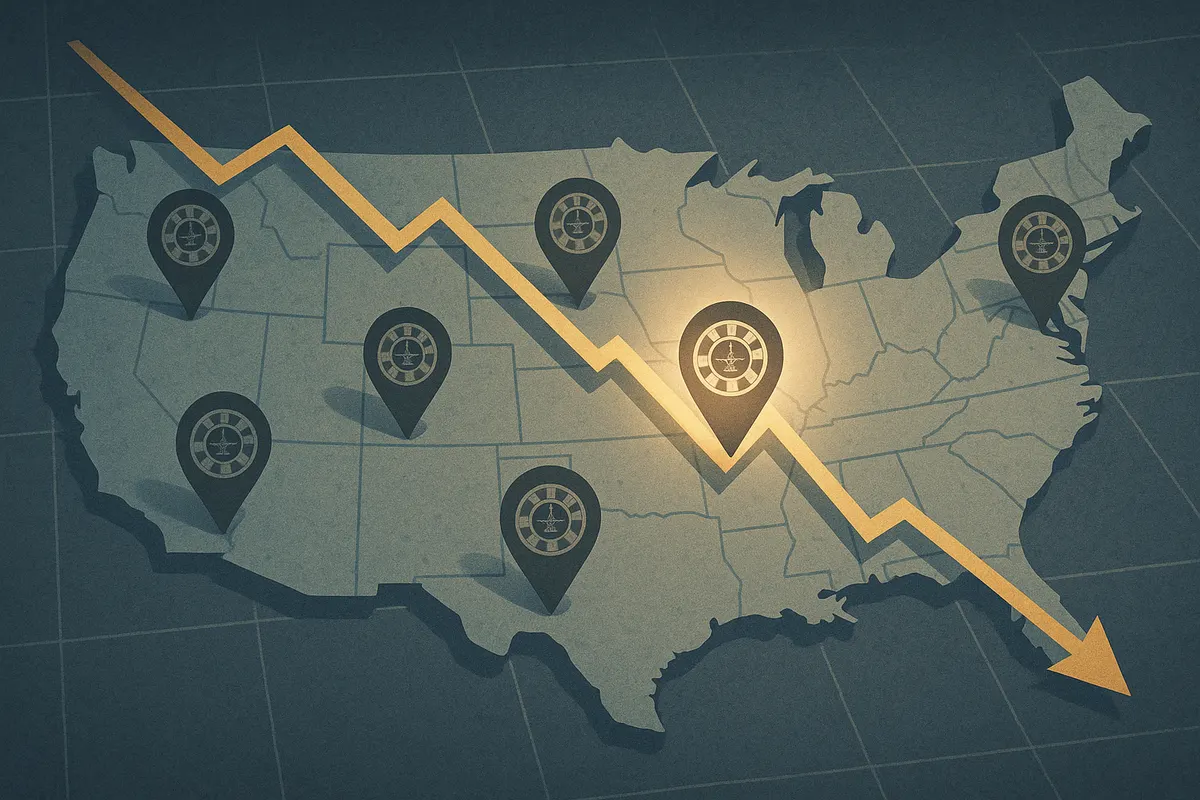
The ledger is the clearest way to see it. In 2022, Michigan’s tribal casinos sent $52.8 million to the Michigan Strategic Fund. In 2025, that figure was $15.4 million, according to Michigan Gaming Control Board data. A 71% collapse in three years, and not because anyone’s slot floor emptied out. The money stopped because tribe after tribe decided the state had stopped holding up its end of the bargain. That bargain is what the industry calls exclusivity, and casino exclusivity deals are the least understood, most consequential contracts in American gambling.
Here’s what actually happened, how these agreements are built, and why the same fight is coming to other states.
What exactly fell 71%, and why?
The number that dropped is a revenue-share payment, not casino earnings. Under Michigan’s tribal-state gaming compacts, tribes agreed to hand the state a percentage of revenue from slots and other electronic casino games. In exchange, they received varying degrees of protection from competing gambling. Those payments flow into the Michigan Strategic Fund, which helps finance the Michigan Economic Development Corporation (MEDC).
Tribes have contributed more than $1.1 billion to the Strategic Fund since revenue sharing began, per reporting by Crain’s Detroit Business. Now almost all of it has stopped. Not through default or hardship, but as a deliberate legal position: the tribes argue Michigan eroded their exclusivity, so the payment obligation attached to that exclusivity no longer applies.
The withholding built up over years rather than arriving all at once.
| Tribe | Casino | Reported state share | Payment status |
|---|---|---|---|
| Pokagon Band of Potawatomi | Four Winds casinos | $11.7 million (2025) | Joined the tribes withholding |
| Nottawaseppi Huron Band of the Potawatomi | FireKeepers Casino Hotel | $18.5 million (prior year) | Stopped in February |
| Gun Lake Tribe | Gun Lake Casino Resort | Not disclosed | Began withholding in 2025 |
| Little River Band of Ottawa Indians | Not disclosed | Not disclosed | Stopped in 2023 |
| Hannahville Indian Community | Island Resort & Casino | About $644,000 (2025) | Paying in full |
Other Michigan tribes ceased payments years earlier. Hannahville is the last one making full state revenue-share payments, and its roughly $644,000 contribution shows how thin the remaining stream is.
The grievances the tribes point to are a timeline of Michigan opening its gambling market: the Michigan Lottery launching online games in 2014, the legalisation of online casinos and sports betting in 2019, horse racing expansion, and more recently prediction markets. Each step, in the tribes’ reading, put a competing product in front of the same customers the compacts were meant to protect them from.
How do casino exclusivity deals work?
An exclusivity deal is a trade: a casino operator accepts a payment obligation to the state in return for a protected market. No new competitor inside a defined zone, or no legal version of a defined product, for as long as the agreement holds. Strip out the protection and the payment loses its justification. That is the entire argument in Michigan, compressed into one sentence.
What exclusivity actually buys a casino
Protection is usually defined in one of three ways, sometimes layered:
- Geographic — no competing licensed casino within a set radius or region, the classic exclusivity zone.
- Product-based — the operator holds the only legal right to certain games, most often slot machines and other Class III electronic gaming.
- Statewide — a limited number of casino licences exist at all, so scarcity itself is the protection.
The value of that protection isn’t abstract. A casino with no rival within an hour’s drive can spend less on promotions, hold better margins on food and hotel rooms, and plan capital projects against predictable visitation. Take away the moat and every one of those assumptions has to be redone.
How the payment structure is calculated
Revenue share is typically a percentage of a defined revenue base, not of profit. In Michigan’s case the base is revenue from slots and other electronic games, which is why online lottery games and online casinos hit such a nerve: they compete directly with the exact product being taxed.
Two details matter more than the headline percentage. First, what’s in the base, because table games, sportsbooks and food and beverage are often excluded. Second, the trigger clause, which specifies what counts as a breach of exclusivity and what happens if one occurs. Some compacts reduce the rate in tiers as competition arrives. Some suspend payments entirely. Many were written before online gambling existed, which is precisely why the language is now being litigated rather than simply applied.
Why do tribal casinos pay states in the first place?
Because federal law leaves a narrow door open, and exclusivity is the key that fits it. The Indian Gaming Regulatory Act of 1988 requires a tribe and a state to negotiate a compact before the tribe can offer Class III gaming, which covers slots, roulette, blackjack and similar games. Class II bingo-style gaming sits outside that requirement. The framework is overseen federally, with the National Indian Gaming Commission handling regulatory functions.
States generally cannot tax tribal gaming revenue. What they can do is negotiate revenue sharing in exchange for something of genuine value to the tribe, and the most common form that takes is exclusivity. That’s the legal logic underneath every compact payment: it isn’t a tax, it’s consideration for a commercial concession. Which is why, when a tribe concludes the concession has evaporated, withholding payment is a coherent legal strategy rather than a tantrum. Gun Lake ran this play once before, withholding after the iLottery launch; the state disputed the interpretation and the two sides reached a partial settlement in 2016.
Worth noting what hasn’t stopped. Michigan’s tribes continue making separate compact payments to local governments, and they still contribute through their online casino and sports betting operations. Tribal and commercial online operators together paid Michigan $624.6 million in state taxes and other payments during 2025. The state’s gambling revenue didn’t disappear. It moved, and the beneficiary changed.
What happens to an operator when competition actually arrives?
The sequence is fairly predictable across markets. Customer dilution comes first, usually hitting the fringes of a catchment area where a rival is now marginally closer. Promotional spending rises, because the cheapest way to defend visitation is to buy it back with comps, free play and loyalty sweeteners. That compresses margins even when handle looks stable.
Then the contracts get reopened. Operators paying for exclusivity that no longer exists go back to the table, or stop paying and force the issue. Online expansion is the harder version of the same problem, because a digital competitor has no catchment area at all. A player who used to drive 40 minutes for slots on a Wednesday night can now open an app. Geographic protection written in 2005 offers no defence against that.
The knock-on effects reach whoever was spending the money. The MEDC has announced layoffs affecting up to 15% of filled and vacant positions, with CEO Quentin Messer Jr. citing declining corporate revenue. Development agencies, local grant programmes and public funds built on gaming revenue all inherit the volatility of the underlying market, and that’s the part policymakers routinely underestimate.
What does this mean for players?
Mostly more choice and sharper competition for your deposit. When exclusivity breaks down, operators fight for the same players, and the usual weapons are bonuses, loyalty tiers and lower-friction sign-ups. In practice that means better welcome offers and more aggressive retention marketing.
Two things to keep your eyes open about. Competition doesn’t improve the underlying math of the games. House edge is set by the game rules and the paytable, not by how many casinos are nearby, and a 4% house edge is a 4% house edge whether the property has rivals or not. What competition does change is the value around the wagering: comps, amenities, payout speed, service. Second, generous headline offers usually carry wagering requirements. A 30x rollover on a $200 bonus means $6,000 wagered before withdrawal, and market pressure tends to push bonus sizes up faster than it improves the terms attached to them. Read the terms, not the banner.
Longer term, mature markets tend to consolidate. Smaller properties without a protected territory or a strong online arm are the most exposed, and the operators with real digital scale absorb the share.
What to watch next
Several Michigan gaming compacts reach potential renegotiation points in 2028 or 2030. Those talks will have to answer a question the original documents never contemplated: what does gaming exclusivity mean when the competing product is an app, a prediction market, or a state lottery’s own online casino-style games? However Michigan settles it, other states with similar compact language will be reading the outcome closely.
If you play in any of these markets, the business side is worth understanding but it shouldn’t shape how you bet. Set a deposit limit, treat losses as the cost of entertainment rather than an investment, and use the self-exclusion and cool-off tools every licensed operator is required to offer. Regulatory and payment data for the state is published by the Michigan Gaming Control Board.