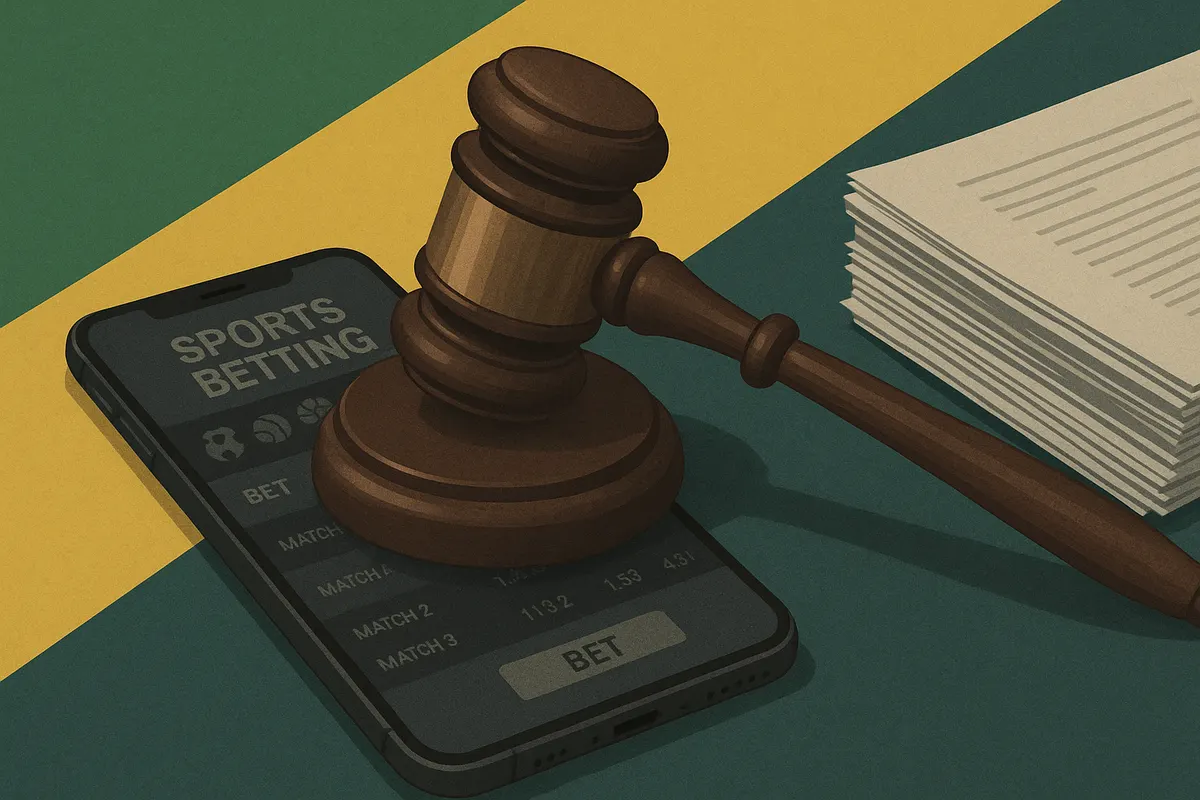
Websites that were taking bets on Brazilian football one week were ordered to go dark the next. A provisional measure from President Luiz Inácio Lula da Silva’s government banned online betting and froze operations, with sites told to stop functioning by 6 October. Then came the part that changes the calculation for everyone in the supply chain: a bill sent to the Chamber of Deputies that turns running or promoting unlicensed betting into a prison offence. The illegal betting law Brazil is now debating, PL 5.477/2026, proposes four to six years behind bars plus a fine for people who operate fixed-odds betting.
That is not a slap on the wrist. It is the kind of number you normally see attached to financial crime, and it tells you exactly how seriously governments have started treating grey-market gambling. For bettors in India, watching from a market with its own patchwork of rules, the lesson travels well: the question “is this site licensed?” has stopped being a technicality.
What the illegal betting law in Brazil actually proposes
The bill was filed by the Executive on 25 September and amends Brazil’s Law No. 13,756/2018, the statute that created the fixed-odds betting framework in the first place. It also reworks the country’s Penal Contraventions Law so that betting-related conduct is clearly handled by the new criminal offences rather than treated as a minor infraction.
The headline penalty is four to six years of imprisonment, plus a fine, for operating fixed-odds betting. The same range is proposed for anyone who offers, receives, registers, processes or intermediates bets, and for those who maintain the establishments involved. Beyond that core offence, the bill creates separate crimes covering advertising, recruiting bettors, the use of personal data, the movement of funds, and supplying the platforms and apps used to place bets.
Read that list again, because it is the most important part. The government did not just criminalise the operator. It criminalised the plumbing.
Timing matters too. A provisional measure has force as soon as it is published but lapses unless Congress confirms it within the constitutional deadline. A bill like PL 5.477/2026 has no effect until it passes the Chamber of Deputies and the Senate and is signed into law, and criminal penalties would apply to conduct after it enters force, not retroactively. Anyone telling you the six-year sentence is already on the books is jumping ahead of the legislative process. You can track the bill’s progress through the Chamber of Deputies’ own records at camara.leg.br.
Myth: “only the big operators need to worry”
This is the comfortable assumption in every grey market, and Brazil’s draft is written specifically to kill it. The proposed unlicensed gambling penalties reach the people who make an illegal operation possible, not just the company whose name is on the site.
- Operators face the core offence: four to six years plus a fine for running or maintaining fixed-odds betting outside the licensed framework.
- Intermediaries are treated the same way, since offering, receiving, registering, processing or intermediating bets all fall inside that same offence.
- Promoters and affiliates are exposed through the separate offences on advertising and recruiting bettors. If your business model is sending traffic to an unlicensed book, the bill has a line with your name on it.
- Payment and tech providers sit inside the offences on moving funds and supplying platforms and applications.
- Data handlers are covered by the offence relating to the use of personal data.
What about the person placing a ₹500 bet? The offences described in the bill are aimed at the supply side, not at individual punters, and that is the standard approach worldwide: governments prosecute the house, not the customer. Fair warning, though, the final text is whatever Congress passes, and a bettor using a banned site still carries practical risk even without criminal exposure, frozen balances, no complaints route, and no one to call when a withdrawal quietly stops arriving.
Myth: “this is just Brazil being Brazil”
It is not an outlier. Stricter betting regulation is the direction of travel almost everywhere, and the reasons are boringly consist.
Tax is the loudest one. A licensed market is a taxable market; an offshore one is revenue leaving the country with no return. Money laundering is the second. Betting platforms move large volumes of small transactions quickly, which is precisely what anti-money-laundering regimes are built to watch, and an unlicensed operator reports to nobody. Third is player protection: deposit limits, self-exclusion, age verification and advertising rules only exist where a regulator can enforce them. Fourth is market control, the plain desire to decide who may sell gambling to citizens and on what terms.
India’s own trajectory rhymes with this. Online money gaming has faced tightening restrictions, advertising scrutiny and tax obligations on winnings, while enforcement attention has fallen on offshore platforms that accept Indian deposits without any local accountability. The specifics differ from Brazil’s. The logic, licence the market or criminalise the alternative, does not.
Myth: “if it says licensed in the footer, it’s licensed”
A footer badge is an image file. Anyone can upload one. Verifying a licence takes about two minutes, and it is the single most useful habit a bettor can build.
- Find the licence number and licensee name in the site’s footer or terms, usually stated as a company name plus a registration number and jurisdiction.
- Go to the regulator’s own website and search its public register. Never use the link on the casino’s page, type the regulator’s address yourself.
- Check the domain matches. Licences are issued for specific URLs and brands. A licence covering one domain does not cover a mirror site with a slightly different spelling.
- Confirm the status is active and note any restrictions on which countries the licence permits.
- Read the withdrawal and KYC terms before depositing, not after your first win.
Recognised gambling regulators include the UK Gambling Commission, the Malta Gaming Authority, the Isle of Man Gambling Supervision Commission, Gibraltar’s Licensing Authority, the Curaçao Gaming Authority and, in Brazil, the Secretariat of Prizes and Betting (SPA) within the Ministry of Finance. The name matters less than the fact that you can find the operator in a searchable public register.
Here is the practical comparison to run in your head before you deposit:
| What to check | Properly regulated betting platform | Unlicensed or grey-market site |
|---|---|---|
| Licence details | Named licensee, number and jurisdiction, verifiable in a public register | Badge image only, vague “international licence”, no number |
| Identity checks | KYC required, clear documents list, stated timelines | No verification, or verification only invented when you withdraw |
| Terms and conditions | Specific wagering requirements, max bet and max cashout limits spelled out | Terms that allow the operator to void winnings at its discretion |
| Game fairness | Games from known studios, RNG and RTP tested by independent labs | Unbranded clones, no testing information, unverifiable RTP |
| Complaints | Named dispute body or regulator-backed ADR route | Support chat and nothing above it |
| Responsible gambling tools | Deposit, loss and session limits, cool-off, self-exclusion, reality checks | Absent, buried, or reset the moment you ask to reopen |
| Payments | Stated methods, fees and payout times, no crypto-only pressure | Shifting payment instructions, third-party personal accounts |
The reddest flag of all is an operator that pays small withdrawals instantly and turns your first large one into a paperwork maze. If you want the longer version of this checklist, our guides to how betting licences work and choosing a safe betting site go deeper.
Myth: “licensed sites just mean more KYC and worse odds”
There is a real trade-off here, and pretending otherwise is dishonest. Licensed operators charge you in friction: identity documents, deposit caps, occasionally tighter margins because they pay tax. Some players resent it.
What you get back is enforceability. Regulated betting platforms in most licensed jurisdictions must keep player funds separate from operating money, so your balance is not the company’s working capital. Their games run on RNGs tested by independent laboratories, and the advertised RTP is a figure someone can be held to rather than a marketing number. There is a complaints escalation path above the operator, and a regulator with the power to fine or pull a licence. Responsible gambling tools are mandatory, not optional. And if the operator breaks its own terms, you have a forum in which that actually means something.
None of that changes the underlying maths. Every betting market carries a bookmaker margin and every casino game carries a house edge, so the house holds the advantage over time on a licensed site exactly as it does on an unlicensed one. Regulation does not improve your expected return. It determines whether you can trust the result and get paid.
Brazil’s bill, if Congress passes it, will settle that question with prison terms. The cheaper version of the same decision is available to you right now, and it takes two minutes in a public licence register.
Quick answers
How long is the prison sentence for illegal betting in Brazil?
The bill proposes four to six years of imprisonment plus a fine for operating fixed-odds betting, and the same range for offering, receiving, registering, processing or intermediating bets. It is a proposal until Congress approves it and it is signed into law.
Does the law punish players?
The offences described target the supply side, operators, intermediaries, advertisers, payment facilitators and platform providers, rather than individual bettors. The final scope depends on the text Congress approves.
Why are governments cracking down so hard?
Tax revenue, anti-money-laundering obligations, enforceable player protection and control over who may legally sell gambling. Unlicensed operators deliver none of the four.
Does a licence guarantee I will win?
No. A licence means tested games, segregated funds and a complaints route. The house edge remains, and betting should be treated as paid entertainment.
Bet only what you can comfortably lose, use deposit and session limits from day one, and if gambling stops feeling like a choice, use the self-exclusion tools every licensed operator is required to offer or contact a local support service.